Services
Three ways to put AI to work in your business
Most small teams don’t need an AI strategy. They need three or four specific jobs done faster – and not by hand.
01 · Operations
AI-Powered Operations
We automate the repetitive work — the copying, the chasing, the re-typing — so you and your team don’t have to. You keep the judgment calls and decision-making.
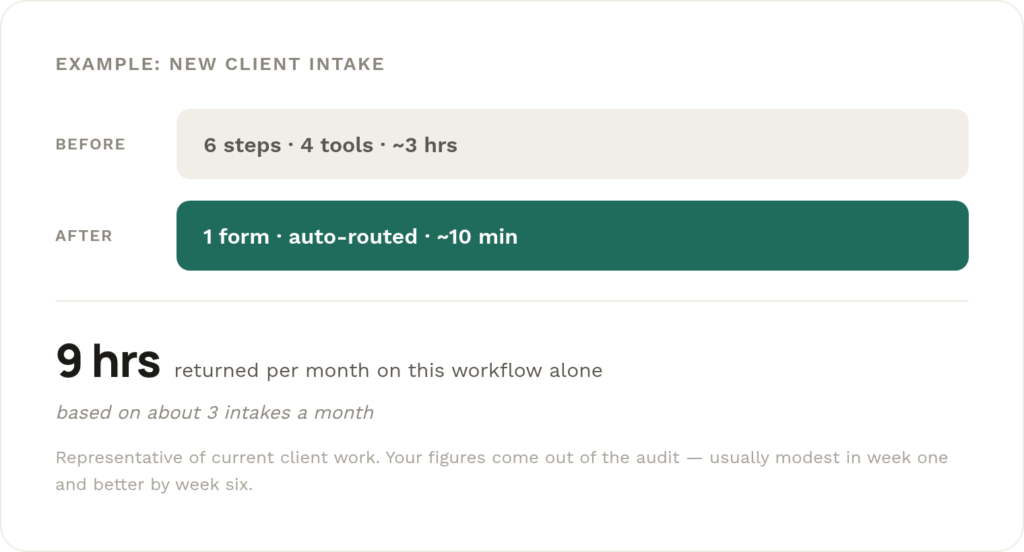
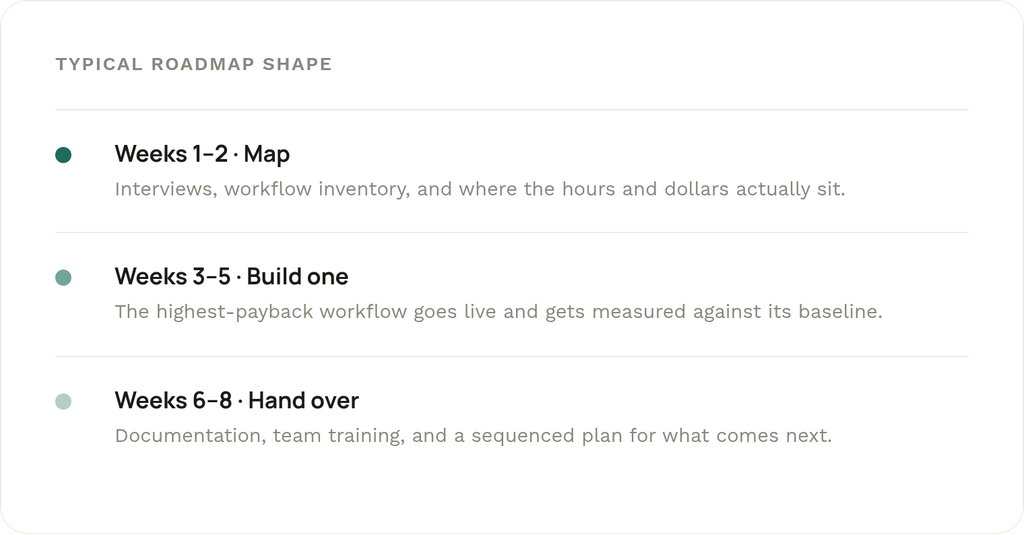
- A workflow audit. Two weeks of watching how work actually moves, not how the org chart says it does.
- Built automations for the three highest-cost workflows — intake, reporting, scheduling, handoffs, whatever yours turn out to be.
- Documentation your team can follow so the system survives without me.
- 30 days of tuning after launch, because the first version is never the last one.
Good fit if your team is capable but buried, and you’re hiring to keep up with admin rather than to grow.
02 · Marketing
Marketing Automation & Growth
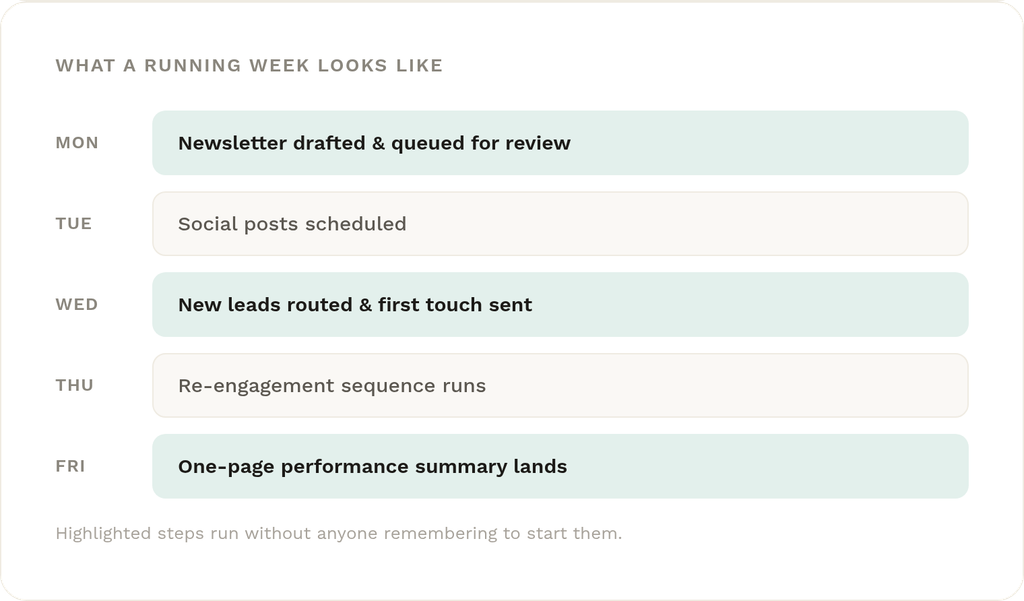
Most small-business marketing fails on consistency, not ideas. The newsletter goes out when someone has a spare afternoon. Leads get followed up on Tuesday, or Thursday, or never. We put the cadence on rails.
- An always-on content engine — drafts generated from your own material, reviewed by you, published on a fixed schedule.
- Lead follow-up that fires in minutes, not days, with responses that sound like you wrote them.
- Campaign reporting you’ll actually read — one page, weekly, showing what moved and what didn’t.
- Honest measurement. I’ve spent a career on incrementality testing, and I’ll tell you when a channel isn’t earning its budget.
Good fit if marketing is one person’s part-time job, or yours, and it’s the first thing dropped when the week gets busy.
03 · Strategy
AI Strategy & Implementation
For when the question isn’t “can you automate this” but “where should we even start.” You get a ranked, costed plan — and then, unlike most strategy work, the first pieces of it actually get built.
- An opportunity map scored on effort, cost and payback — including the things not worth doing.
- Tool selection with reasons, sized to your team — not the enterprise stack a bigger firm would sell you.
- A first system live inside the engagement, so you’re evaluating something real rather than a slide.
- A plain-language risk review — where your data goes, what stays in-house, what to keep a human on.
Good fit if you’ve been asked “what are we doing about AI” and want an answer that isn’t a pilot that quietly dies.
How engagements run
Same three steps, whichever service you start with
Step 01
A free 30-minute call
You describe where the week goes. I tell you honestly whether there’s something here worth paying for — sometimes there isn’t yet.
Step 02
A Scoped Proposal
Fixed price, named deliverables, a date. No hourly billing and no open-ended retainers.
STep 03
Build, measure, hand over
You get working systems and the documentation to run them, not a dependency on me.
Ready to see where AI actually helps your business?
Start with a free 30-minute consultation — no pitch deck, just a look at what’s worth automating first.
Free Consultation
•
Dedicated Support
•
100% Satisfaction